As gaming retreats, AI giants move to own cricket pitch
OpenAI and Google’s partnership with BCCI & ICC marks the arrival of the next heavyweight advertiser category, industry executives say
 by
by
Published: Feb 25, 2026 9:39 AM | 5 min read
 Follow Us

- The ICC announced Google Gemini as the Official AI Fan Companion for the ICC Men’s T20 World Cup 2026, marking a significant shift in cricket sponsorship dynamics, alongside Google Pixel as the Official Smartphone.
- Gemini secured a ₹270-crore, three-year partnership with the BCCI starting IPL 2026, integrating AI into various fan experiences, while ChatGPT has also partnered with the Women’s Premier League for the 2026–27 cycle.
- Industry experts suggest these partnerships signify the emergence of generative AI platforms as a new key advertising category in cricket, filling the gap left by declining spending from gaming and edtech sectors.
- With over 800 million internet users and a young digital population, India is becoming a crucial market for AI adoption, positioning cricket as a key battleground for technology brands to establish dominance.
Last week, when the International Cricket Council (ICC) announced Google Gemini as the Official AI Fan Companion for the ICC Men’s T20 World Cup 2026 — alongside Google Pixel as the Official Smartphone — the announcement marked more than another sponsorship deal. It signalled a structural shift in cricket’s advertiser mix.
The move followed Gemini securing a reported ₹270-crore, three-year partnership with the Board of Control for Cricket in India (BCCI) starting IPL 2026, integrating artificial intelligence across broadcast, digital and on-ground fan experiences.
Multiple Google brands, including Pay, Android and Pixel, have simultaneously aligned with JioStar’s expanding cricket ecosystem.
Read more: ICC's partnership with Google
OpenAI has followed a similar playbook. ChatGPT has come on board as a Premier Partner for the Women’s Premier League (WPL) for the 2026–27 cycle in a deal estimated at ₹16 crore.
Taken together, industry executives say, these partnerships mark the formal emergence of generative AI platforms as cricket’s next high-potential advertiser category — filling a vacuum left by retreating gaming and edtech spenders.
“Most sponsors typically spend over twice the rights fee on advertising, marketing and on-ground activations,” says sports marketing expert Arun Rao. By that metric, he estimates Google Gemini’s overall investment linked to the IPL could approach ₹500 crore over three years, with another ₹200 crore around ICC tournaments across media and promotional spends. However, this is just the beginning.
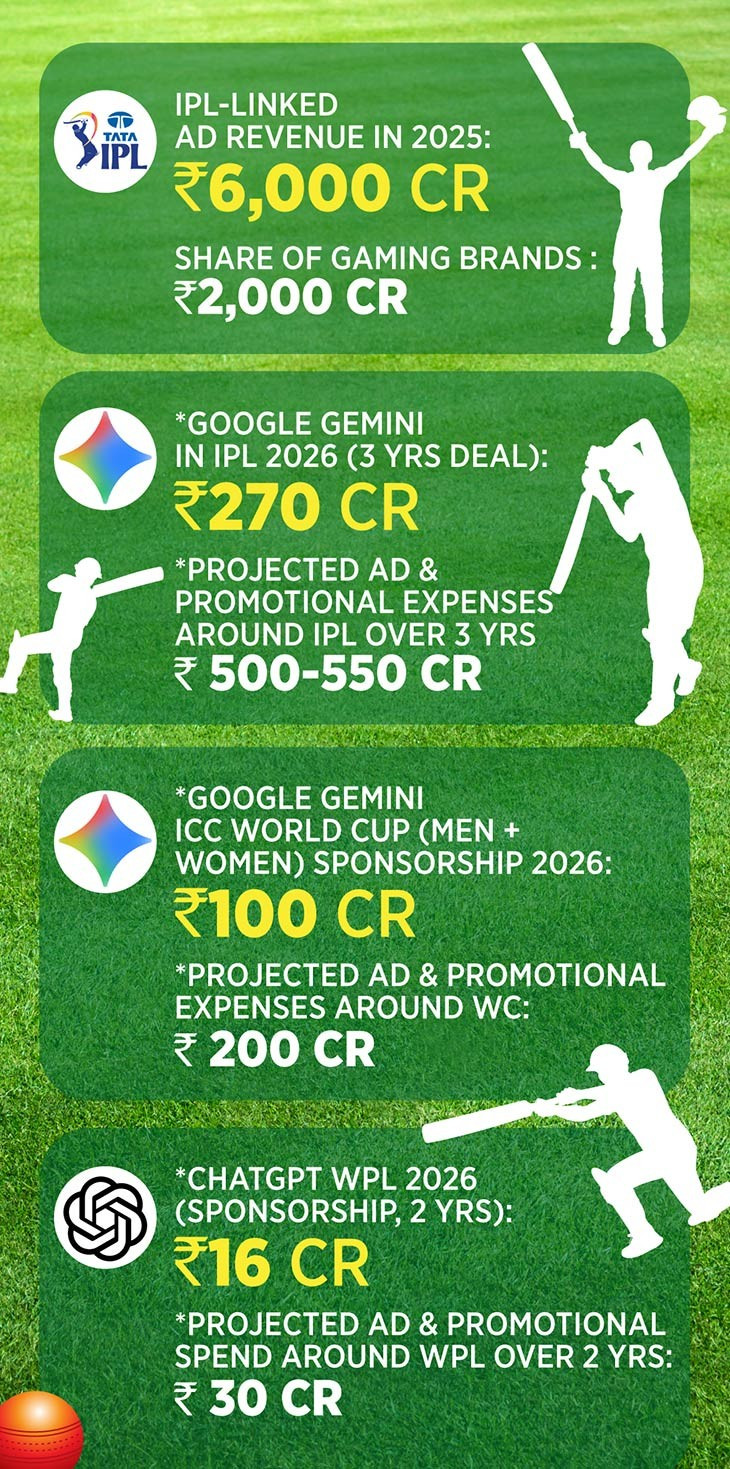
The long-term orientation is notable. IPL advertising revenues for 2025 are estimated at nearly ₹6,000 crore across television, digital and sponsorship inventory — roughly 6% of India’s total advertising expenditure. The WPL, meanwhile, has crossed ₹110 crore within four seasons and continues to expand.
Interest is already expanding beyond core AI developers. Design platform Canva, for instance, was among bidders for Team India’s jersey sponsorship rights last year. After losing the race to Apollo Tyres, the company came on board as title sponsor of the popular reality show - Shark Tank India Season 5 (ongoing).
Cricket becomes AI’s mass adoption stage
For over a decade, the IPL has reflected India’s evolving digital economy — telecom during the 4G expansion, fintech through the UPI boom, and gaming and edtech during the pandemic years. Artificial intelligence now appears to be stepping into that role.
Regulatory tightening and funding pressures have sharply reduced marketing outlays from real-money gaming, crypto and edtech firms — once among cricket’s most aggressive advertisers. Industry estimates suggest gaming platforms alone contributed nearly ₹2,000 crore annually at peak intensity, accounting for up to 30 per cent of IPL advertising revenues.
As that spending engine slowed, broadcasters and rights holders began searching for a replacement category capable of sustaining high media intensity.
AI companies, executives say, are emerging as natural successors.
“The entry of AI platforms like Google Gemini and ChatGPT marks a shift from visibility-led marketing to utility-led demonstration,” says Nikhil Bardia, Head of RISE Worldwide. “The IPL offers a live environment where technology impact can be experienced in real time, not just advertised.”
Unlike earlier digital categories driven by venture capital expansion, AI firms are positioning cricket partnerships as product demonstrations — embedding tools into fan engagement, analytics and personalised experiences.
A familiar playbook
Naveen Khemka, President – Client Solutions at WPP Media, sees echoes of earlier competitive cycles.
“OpenAI and Google’s entry reminds me of past category battles — Pepsi versus Coke, Oppo versus Vivo, Dream11 versus My11Circle,” he says. “When a new category wants to establish dominance at scale, cricket becomes the battleground.”
Cricket’s unmatched reach across demographics makes India central to that ambition. “Anyone with a smartphone is a potential AI user,” Khemka adds. “These investments are about accelerating adoption in a priority market.”
From enabling advertising to becoming advertisers
The deeper transition lies in AI’s evolving role within marketing itself.
For years, artificial intelligence functioned largely as backend infrastructure powering targeting, optimisation and recommendation engines. It is now emerging as a consumer-facing brand category competing directly for attention.
“The entry of OpenAI and Google Gemini signals a shift from speculative digital categories to foundational technology brands,” says Anil Solanki, Media Lead at dentsuX. “This reflects confidence in India not just as a branding market, but as a large-scale AI adoption ecosystem.”
Unlike short-cycle sectors such as edtech or crypto, he adds, AI represents an infrastructure layer expected to integrate across productivity, education, finance and enterprise applications — positioning it as a sustained advertising category rather than a cyclical one.
Why India matters
India’s scale makes the transition inevitable. With more than 800 million internet users, rapid smartphone penetration and a young digital-first population, the country has emerged as one of the fastest-growing markets for generative AI adoption.
OpenAI chief Sam Altman recently said India is ChatGPT’s second-largest global market, with over 100 million weekly active users. The company opened a New Delhi office in 2025 and introduced local pricing tiers to accelerate adoption.
Google, meanwhile, says India now leads global daily usage of Gemini for learning applications, underscoring how the market is shaping both user growth and product development.
As AI platforms scale consumer ambition, cricket — once again — is becoming the arena where India’s next technology race is being fought.
Read more news about Marketing News, Advertising News, PR and Corporate Communication News, Digital News, People Movement News
For more updates, be socially connected with us on
Instagram,
LinkedIn,
Twitter,
Facebook,
YouTube
&
Google
News